Set & era context
Grading economics
GRADEPopulation by grader
Hand-curated approximations of public pop data as of 2026-05-04 — refreshed via partner integration.
Price history
Price history materializes as prices_raw_history accumulates.
No historical observations on file yet.
Analysis
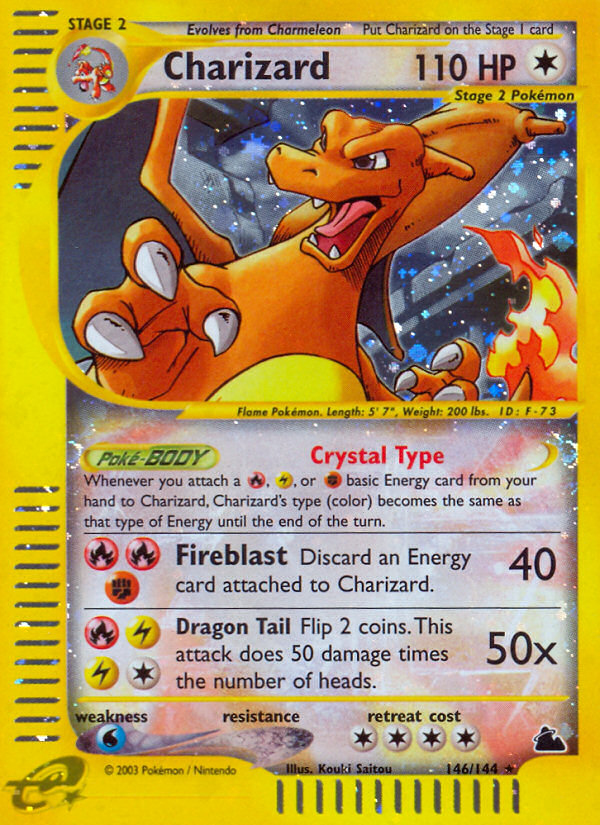
Charizard (Skyridge Crystal Holo) comes out of Skyridge, which I've slotted into the WOTC Era era on Cardboard Assets. That basket has returned +34,276 pp relative to the S&P 500 Total Return across 14 tracked products, with a 24.0% CAGR against SPXTR's 8.7%. Total invested at retail across the era runs roughly $2,016; basket value today is $710,909. That number's a little misleading — 77% of basket value sits in the era's top 3 products, so generalizing the era return to any individual card requires care.
Raw spot sits at $1,400 per the most recent PriceCharting loose comp. The last documented sale closed at $1,400 on 2026-04-26, so the market's barely moved since. The trailing 90-day sample is 18 comps, which I'd call moderate.
PSA has graded 1,140 copies of this card. The Grade 10 rate is 8.1%, Grade 9 lands 54.4%. PSA 10 / PSA 9 spread is $7,300, with PSA 10 trading at roughly 4.3× the PSA 9 comp. That's a strong gem premium — Grade 10 demands a real price multiple over Grade 9.
Run those numbers through the optimizer and the verdict is GRADE at PSA. Expected value works out to $2,264, less raw, less fees, less shipping, gets to a net of $835 per card sent in. ROI is roughly +60% off the $1,400 raw cost. Most of that EV comes from Grade 9 — that's the bucket I'm effectively betting on when I send this in.
Risk worth flagging: pop counts grow. If grading volume jumps in the next 12 months and the population doubles, the gem-rate denominator gets larger and Grade 10 comps soften. Hard to call where this trends if a major influencer pushes a fresh round of submissions, or if a grader rolls out a service-tier promo that pulls in a wave of marginal copies. My read: the math holds at current pop counts. Watch the 12-month grading volume — that's the lever that reshapes this thesis.
Bigger picture: the era basket I'm benchmarking against is dollar-cost-averaged at MSRP across 14 sealed products as they released, then compared head-to-head against the same dollars dropped into the S&P 500 Total Return on the same dates. That's the honest baseline — not a lump-sum-at-inception comparison, which would flatter the cardboard side. Even so, this card's era ran a 24.0% CAGR. Numbers above pull from PSA POP Report, recent eBay sold listings, and PriceCharting loose comps as of 2026-05-04. Coverage expands when our commercial pop-data partner integration completes.
Frequently asked questions
Computed from real comps, pop data, era benchmarks, and the grading optimizer. See PSA 10 sold listings on eBay →
- What is the current price of Charizard (Skyridge Crystal Holo)?
- Raw market price for Charizard (Skyridge Crystal Holo) is currently unavailable in our snapshot.
- Is Charizard (Skyridge Crystal Holo) worth grading?
- Yes — the grading optimizer rates this card GRADE. Projected net profit after grading fees, return shipping, and eBay sales fee is +$11,786 via PSA. Run the per-grade math at cardboardassets.com/tools/grading-optimizer/?card=skyridge-146-charizard-skyridge-crystal-holo.
- Where does Charizard (Skyridge Crystal Holo) rank in Skyridge?
- Charizard (Skyridge Crystal Holo) is the highest-priced card in Skyridge (#1 of 1). Browse the full set with movers, grading opportunities, and era benchmark at cardboardassets.com/sets/pokemon/skyridge/.
- Where can I buy Charizard (Skyridge Crystal Holo)?
- TCGplayer is the highest-liquidity raw-card marketplace. eBay sold-listings filter shows real recent transaction prices (asking prices alone are noise). Both options linked from the card page.